
Here is where we share articles we have written or read*
*please be careful of copyrights
I believe that one real source of this attitude is that children are not taught to love the worship of the Lord. From the time they are infants the parents are yelling at them on Sundays to "hurry up and get up ‘cause we have to go to church" with the emphasis on "have." Nothing is said about the joy of worship. Nothing is said about the wonderful privilege that is ours. Children are taught that "going to church" is a drudge. No wonder they want to get away from it.
When children are in the assembly, often they are allowed to play with all sorts of toys and games. This causes them to think that the assembly is some place to play games; and then when they are older and too big to play games, they are bored with what is going on. Many children are not taught to sing. They are allowed to play when worship to God in song is being rendered. If they are not taught to sing as tiny tots, then as they grow older they will not sing. Parents, do you teach your children the words to songs at home so they will know them and be able to join in the singing? It is a sad sight to see teenagers just sitting and looking around instead of singing. No wonder they have no interest. They are not taught reverence during prayer. They keep on playing instead of being taught to always bow their heads in reverence. If you took your child to the funeral of a loved one, would you give him games to play? Would you allow him to "do his own thing" or would you teach him reverence and respect for the dead? No, our worship is not a funeral, but it is holy and children need to be taught that it is.
They must be taught to study the Word. Are you studying the class lessons with your children every day? Are you teaching them to enjoy that part of the day and really look forward to it? If this is the environment of a child, you will seldom see him wander away from the Lord. Those who are taught to study the Bible are the ones who listen to sermons and lessons. They are the ones who will understand much more of the lessons that are being presented. (And, by the way, what happened to the teenagers all sitting at the front? What an inspiration that is to the whole congregation!) These are the ones who grow up to love the Lord and stay with Him.
Friend, what are you teaching your children? To love God and His worship, His word, and His people? What you teach your child, who is a tiny tot now, will determine where he will be when he is old. Seems like Solomon said something like that somewhere.
Guiding Your Children into the Joy of Worship*
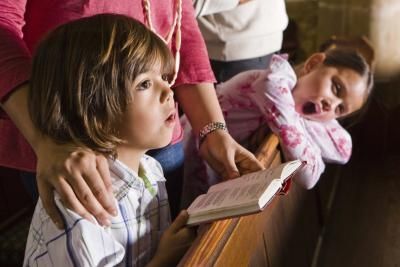 The Manassas Church of Christ is committed to worshipping God as a diverse community - people of various cultures, background and ages. As a parent, you have the joy and responsibility of helping your children learn to be a part of this community's corporate worship. The following are some ideas that will help with this awesome, yet rewarding, responsibility.
- Children should sit with parents or a trusted adult friend/mentor who will help to guide them through the worship service.
- Sitting near the front will help children of all ages see, hear and focus on the content of the service.
- Prepare your children for worship in advance. Help children go to bed at an reasonable time on Saturday night, have breakfast Sunday morning, and go to the bathroom before the service starts! Before the service talk with your children about how God has blessed us with the opportunity to worship.
- Instead of feeling that you must distract your children so that they will stay quiet, try to creatively involve your children in the service. Whispers between children and adults are far preferable to silent children who are not understanding the worship service! There are many ways to help children understand and participate in worship.
- Have your children join in the activities of worship - stand when the congregation stands, sing when the congregation sings, pray when the congregation prays, follow along with the scriptures readings, pass the communion trays and place coins in the collection plate.
- Quietly ask your children questions about the worship experience. For example, ask younger children, "Can you find the word 'love' in this scripture?" Ask older children, "How so you think the disciples felt when Jesus said this?"
- Wait until the sermon begins to give children coloring or reading materials. While younger children can learn to color quietly during the sermon, older children can listen to the sermon and participate in activities that correspond to the sermon's theme. For example, they might list and draw the fruit of the spirit, or draw a cartoon that illustrates the meaning of the word "mercy."
- Parents may feel that it will be "distracting" to help their children worship. While this may be true at times, the inconvenience is far outweighed by the value of worshiping God as a family. Additionally, parents will be blessed by the opportunity to see worship through the eyes of their children. We remember Jesus' words, "I tell you the truth, unless you change and become like little children, you will never enter the kingdom of heaven." (Mt. 18:3)
Good husband-wife, parent-child relationships are a must in building the home.
Satan has sought to destroy the home by attacking the divine order. Roles have been replaced, redefined or left without definition. Today there are live-in lovers, homosexual
marriages, invitro and surrogate homes.
In many homes there is no head. Instead of wives encouraging and helping their husbands to lead their families, in some cases they have taken over the homes. In other homes, the men are missing altogether. Too many husbands and fathers have neglected their responsibilities in the home. Some are abusive and dictatorial and give little consideration to their family.
Children do what they want. Parents are afraid to punish them. Their training has been turned over to the television or the YMCA. A visitor from the Orient was once asked what he thought was the most amazing thing about America? "How well the parents obey their children," he answered.
We need to return to God's design for the home. Wives, submit to your own husbands, as to the Lord. For the husband is head of the wife, as also Christ is head of the church; and He is the Savior of the body. Therefore, just as the church is subject to Christ, so let the wives be to their own husbands in everything. Husbands, love your wives, just as Christ also loved the church and gave Himself for it... So husbands ought to love their own wives as their own bodies; he who loves his wife loves himself. For no one ever hated his own flesh, but nourishes and cherishes it, just as the Lord does the church...Children obey your parents in the Lord, for this is right. "Honor your father and mother," which is the first commandment with promise: "that it may be well with you and you may live long on the earth." (Eph. 5:22-25, 28-29; 6:1-4; also cf. Col. 3:18-21; 1 Pet 3:1-7)
Until we get back to the divine order there will be no chance for a real home in the houses in which we live.
Introduction
Before God ever said “let there be light” (Gen. 1:3), He had, in His mind, already said, “let there be a church” (Eph. 3:9-11; 1 Pet. 1:20; Acts 20:28). As the Old Testament story unfolded, numerous prophecies predicting the coming of the church were recorded by inspired prophets of God. For instance, God told David that after he was dead and buried one of his descendants would “build an house for my name” (2 Sam. 7:12-13). According to 1 Timothy 3:15, the house of God “is the church of the living God.” Therefore, the Bible teaches that after David was dead and buried the church would be built.
Furthermore, Old Testament prophets revealed that this house or church would be established in “the last days” in the “top of the mountains, and shall be exalted above the hills; and all nations shall flow unto it. And many people shall come and say, Come ye, and let us go up to the mountain of the Lord, to the house of the God of Jacob; and he will teach us of his ways, and we will walk in his paths: for out of Zion shall go forth the law, and the word of the Lord from Jerusalem” (Isa. 2:2-3; cf. Micah 4:1-4). In summary, these passages show that the church would be established: (1) after David was dead and buried; (2) in the last days; (3) in Jerusalem.
In Matthew 16:18-19, after hearing Peter confess that He was the Christ, the Son of the living God, Jesus said:
And I say also unto thee, That thou art Peter, and upon this rock I will build my church; and the gates of hell shall not prevail against it. And I will give unto thee the keys of the kingdom of heaven: and whatsoever thou shalt bind on earth shall be bound in heaven: and whatsoever thou shalt loose on earth shall be loosed in heaven.
From this passage we may ascertain the following things: (1) The church of Jesus Christ had not yet been built; (2) The church would be built upon the truth that Jesus is the Christ, the Son of the living God; (3) The church is the same thing as the kingdom for it would be ludicrous for Jesus to build one thing and give Peter the keys to something else; (4) The church would be governed by the apostolic authority conferred upon the apostles by Jesus Christ.
Since the church is the same thing as the kingdom, when John the Immerser prepared the way for the Lord by proclaiming that the kingdom of heaven was “at hand” (Isa. 40:3-5; Matt. 3:1ff), he was essentially saying that the establishment of the church was “at hand.” Even Jesus began traveling around the region of Galilee, saying, “Repent, for the kingdom of heaven is at hand” (Matt. 4:17). After calling the twelve apostles, He dispatched them on a mission to go to the lost sheep of the house of Israel, saying, “And as ye go, preach, saying, The kingdom of heaven is at hand” (Matt. 10:7). He sent out the seventy, instructing them to tell their hearers “The kingdom of God is come nigh unto you” (Luke 10:9). In fact, the coming of the kingdom was so near that Jesus promised some that they would not die until they had seen the kingdom come with power (Mark 9:1). Just prior to His ascension Jesus commanded His disciples to tarry in Jerusalem until they received power from on high (Luke 24:49). This power would come upon the apostles after the Holy Spirit came upon them (Acts 1:8).
Thus, from the paragraphs above we have learned the following things about the church of Christ: (1) It was in the eternal purpose of God; (2) It would be established after David was dead and buried; (3) It would be established in Jerusalem; (4) It would be established in the last days; (5) It would be built by Christ; (6) The time of its establishment was “at hand” during the days of John the Immerser, Jesus, and the apostles; (7) It would be established during the lifetime of some of those whom Jesus addressed in Mark 9:1; (8) It would come with power; (9) The power would come from on high; (10) The power would come after the Holy Spirit came upon the apostles.
When Did The church of Christ Begin?
If we can find an event in recorded Scripture where all of the above criteria are found, then we can truly say that we have found the time when the church of our Lord Jesus Christ was established. Is there such a Scripture? Indeed, we find such a passage in the second chapter of the book of Acts. Consider the evidence. The power of the Holy Spirit fell upon the apostles (Acts 2:1-4). The events on this day of Pentecost took place in Jerusalem (Acts 2:5). Devout men, out of every nation under heaven were gathered together (Acts 2:5). Peter confirmed the time period as being “the last days” (Acts 2:16-17). Peter made reference to the pivotal fact that David was dead and buried (Acts 2:29). Peter gave great emphasis to the fact that Jesus was both Lord and Christ (Acts 2:36; cf. Matt. 16:18-19).
Upon seeing and hearing these things, the cry came forth from the crowd, “Men and brethren, what shall we do?” The reply came swiftly and surely, “Repent and be baptized every one of you in the name of Jesus Christ for the remission of sins, and ye shall receive the gift of the Holy Spirit” (Acts 2:37-38). About three thousand souls gladly received this word and were baptized (Acts 2:41). Moreover, the Record says that these souls were added—but to what were they added? The answer is in verse 47: “And the Lord added to the church daily such as should be saved.” Hence, there it is in plain black and white—the church was in existence as of Acts 2 because people were being added to it. Never before this time is the church spoken of as being in existence, and always after this time the church is spoken of as a reality. As has often been said, everything in the Scriptures before Acts 2 points forward to it, and everything after Acts 2, in some way, points back to it. No wonder it is called “the hub of the Bible!”
Yet, there is still a crucial question that must be addressed. We know that a church was established on the day of Pentecost, but what church was it? Perhaps the better way to ask the question is “Whose church was it?” Would anyone dare to affirm that the church established in Acts 2 belonged to the Pope of Rome? Was it the church belonging to Martin Luther? John Calvin? Was it the church of John Wesley? Whose church was it, anyway? Obviously, the church we read about in Acts 2 was the church belonging to Christ. After all, He is the builder of the church (Matt. 16:18), the purchaser of the church (Acts 20:28) and the head of the church (Col. 1:18). The church of Christ is the church He owns and over which He reigns. It is not a manmade denomination patterned after the doctrines and commandments of men.
Imagine having a conversation with the nearly three thousand souls who were baptized on the day of Pentecost and added to the church. If you had been present on Pentecost and you had asked those who were baptized to tell you what church they were members of, how would they have replied? Would they have identified themselves as members of some well-known modern day denomination? If someone had asked those who were baptized on Pentecost, “what denomination are you a member of,” the multitudes saved on that day would have been bewildered and confused by the question; there were no modern day denominations in existence at that time. There were sectarian religious groups in existence (such as the Pharisees and the Sadducees) but there were no modern day denominational churches in existence at that time. Indeed there was a church in existence at that time, but it was not a manmade denominational organization. Those who were baptized on Pentecost were added to the church of Christ, i.e., the church that belonged to Christ.
The early recipients of salvation on Pentecost did not go their separate ways and divide up into different denominational organizations. They knew nothing of the manmade names and titles that are so popular in the religious world today. They were not associated with any denominational church, but they were members of the church of Christ, not a modern day denomination known as the Church of Christ, but the actual church of Christ established on Pentecost. Consequently, when Paul wrote the Romans he said, “the churches of Christ salute you” (Rom. 16:16). He was not referring to a group of denominational churches that had chosen to identify themselves with a particular denominational name. Paul deplored religious division patterned after men and named after men (1 Cor. 1:10-13). When Paul referred to “the churches of Christ” he was referring to that group of individuals who had been called out of the world to become members of the church built and bought by Christ, the church of Christ!
The conclusion is inescapable. Any church that originated after the Day of Pentecost could not possibly be the Lord’s church. Please observe that we are not saying that any church established after the Day of Pentecost, but following the same apostolic pattern as the church in Jerusalem, constitutes a manmade church. We are saying that any church that originated after Pentecost, that does not follow the apostles doctrine (Acts 2:42; John 14:26; 16:13; 1 Cor. 14:37) is a manmade church, and that we should have no desire to be a part of it.
What Is Distinctive About The church of Christ?
It Has A Distinctive Pattern
Whereas manmade churches follow “the doctrines and commandments of men” (Matt. 15:8-9), the Lord’s church follows “the doctrine of Christ” (2 John 9). The first century Christians were not adherents to the Law of Moses, for Jesus had nailed it to the cross (Col. 2:14). The old covenant was replaced by a new covenant, a better covenant with better promises (Heb. 8:6-13; 9:15-17). The church of Christ in Jerusalem was guided and governed by the apostles’ doctrine (Acts 2:42). The things that Paul taught the Corinthian church were said to be “the commandments of the Lord” (1 Cor. 14:37). The church was not then, nor should it be now, loyal to the creeds, manuals and catechisms of uninspired men. The motto of 1 Peter 4:11, if practiced consistently by the religious world, would lead to the practice of distinctive New Testament Christianity.
It Has A Distinctive Plan Of Salvation
The plan of salvation, preached by the early church, is not at all difficult to determine. A combination of the following passages teaches that men needed to hear the Word of God (John 6:44-45; Rom. 10:17; Acts 2:37), believe that Jesus Christ is the Son of God and the only Saviour (John 8:24; Acts 4:12), repent of sins (Luke 13:3; Acts 2:38; 17:30), confess Christ (Acts 8:35-37; 1 Tim. 6:12), and be immersed in water in order to be forgiven by the blood of Christ and enter the church of Christ (1 Pet. 3:20-21; Mark 16:16; Acts 2:38; Eph. 1:7; Rev. 1:5; 1 Cor. 12:13; Acts 2:41,47).
In spite of the abundantly clear teaching of the New Testament on the matter of how to be saved, the religious world heralds a vastly different message. For example, multitudes are instructed to pray “the sinner’s prayer,” asking Jesus to come into their heart to save them from their sins. Such a prayer is in direct opposition to the revealed will of God. The fabled “sinner’s prayer” is a concoction of the doctrines and commandments of men, and cannot be substantiated with book, chapter and verse. Where is the verse in the New Testament where an inspired preacher ever encouraged a sinner to say the sinner’s prayer in order to be saved? Where is it? When convicted sinners on the Day of Pentecost cried out asking what to do to be saved, Peter did not invite them to bow their heads and invite Jesus into their heart. Rather, he commanded them to repent and be baptized for the remission of sins (Acts 2:38). Why won’t denominational preachers give this same command to men and women today?
Further proof of the inefficacy of prayer to save the alien sinner is seen in the conversion of Saul of Tarsus. On the road to Damascus, fully intending to wreak more havoc upon Christians, Saul was, instead confronted with a vision of the Lord. Trembling and astonished, he asked what the Lord would have him to do (Acts 9:6). Isn’t it interesting to observe that the Lord did not tell Saul just to say a little prayer? Rather, the Lord directed Saul to go into Damascus and wait for a preacher to come and tell him what to do (Acts 9:6).
Subsequently, God gave instructions to Ananias to go and preach to Saul. He told Ananias what house to find Saul in, and even told him what Saul would be doing when he got there. The Lord said of Saul, “for, behold he prayeth” (Acts 9:11). This important fact should not be hurried over. Though we do not have a word for word record of Saul’s prayer, it is not at all incredible to believe that Saul confessed his anguish and guilt to God in the midst of his prayer. Furthermore, as he prayed, Saul was now convinced of the deity of Jesus Christ.
Does this mean that Saul of Tarsus was saved by his prayer? The statement of Ananias quoted in Acts 22:16 clearly gives us the answer. Upon arriving, Ananias said, “And now why tarriest thou? Arise, and be baptized, and wash away thy sins, calling on the name of the Lord.” The statement of Ananias proves conclusively that Saul’s sins had not yet been washed away! Otherwise, why would Ananias tell Saul to have his sins washed away if such had already taken place on the road to Damascus? Moreover, if Saul’s penitent prayer had saved him, why then did Ananias tell him to be baptized in order to have his sins washed away?
In fact, the Biblical record suggests that Paul was in a prayer posture when Ananias arrived. Consider Paul’s own testimony. Paul said, Ananias “came unto me, and stood,…and the same hour I looked up upon him” (Acts 22:13). According to Paul, it was Ananias, who was standing, and it was Paul who looked up upon him. Furthermore, Ananias told Saul to arise. So what is the point? The point is this: if salvation comes through saying a prayer, then why did Ananias tell Saul to get up from his prayer posture in order to be baptized to have his sins washed away? What would most denominational preachers have told Saul, if they had arrived upon the scene? Likely, they would have encouraged him to remain in his prayer posture and to repeat after them the words to the so-called sinner’s prayer.
Perhaps the objection will be offered that Acts 22:16 says that Saul’s sins would be washed away, not when he was baptized, but rather when he called upon the name of the Lord. In response, we affirm that the penitent believer calls upon the name of the Lord when he is baptized. Proof of this affirmation is discovered by combining Acts 2:21 and Acts 2:38. Peter promised the Pentecostians that they would be saved if they called upon the name of the Lord (Acts 2:21). Just seventeen verses later, Peter told the same people to repent and be baptized for the remission of sins (Acts 2:38). Is the phrase “shall be saved” in Acts 2:21 the same thing as “remission of sins” in Acts 2:38?
In other words, can someone who be saved who has never received remission of sins? Such an idea is absurd! The conclusion is this: Since the “shall be saved” of Acts 2:21 is equal to the “remission of sins” of Acts 2:38, then it must also be the case that calling upon the name of the Lord (Acts 2:21) is equal to repenting and being baptized (Acts 2:38). If calling upon the name of the Lord makes us saved, then it also gives us remission of sins. But remission of sins comes only if we repent and are baptized (Acts 2:38). Therefore, to repent and be baptized is equal to calling upon the name of the Lord! Such a conclusion harmonizes beautifully with the conversion of Saul.
One thing is certain. The denominational definition of calling upon the name of the Lord as being equivalent to believing in Jesus is insufficient and unscriptural. Romans 10:13 declares that whosoever shall call upon the name of the Lord shall be saved. Please give special attention to the very next sentence that Paul wrote. In verse 14, Paul asked, “How then shall they call on him in whom they have not believed?” What’s that, Paul? Are you saying that one can’t call upon the name of the Lord until they have first believed upon Him? That’s exactly what Paul is saying. Therefore, since believing comes before calling, there must be a distinction between the two.
Furthermore, look at the sequence. One can’t be saved unless they have called upon the name of the Lord. But since believing comes before calling, one is not yet saved at the moment he believes. After believing, one still must call upon the name of the Lord. We have already learned that calling upon the name of the Lord in Acts 2 was equivalent to repenting and being baptized. Therefore, the scriptural order is: 1) Believing and 2) Calling on the name of the Lord (repentance and baptism).
Isn’t this the order of events on Pentecost? Upon hearing the inspired preaching of the apostles, the people came to the belief that Jesus was the Christ. Peter told these guilt-ridden believers that they should repent and be baptized for the remission of sins. On Pentecost, it was belief, repentance and baptism, in that order. This same order can be seen in the conversion of Saul. Upon seeing the Lord, he became a believer in His deity. This realization prompted him to show penitence. He then called upon the name of the Lord by being baptized to wash away his sins. That is the Biblical order and man has neither the right nor the power to alter it.
Two other passages are often appealed to as proof that one can pray to God for forgiveness of alien sins. The prayer of the publican (Luke 18:13) is claimed to be a clear example of someone praying to God for salvation. The thief on the cross is also alleged to be an example of someone who was saved by simply expressing his petition to Jesus. In the first place, it should be observed that both of these occurrences took place under the Old Testament system. Both requests for salvation transpired prior to the death of Jesus.
The significance of this fact is appreciated when we read Hebrews 9:15-17. According to this text, Jesus is the mediator of the New Testament. However, the New Testament, like any other testament, could not come into force until its testator died. “A testament is of force after men are dead: otherwise it is of no strength at all while the testator liveth” (Heb. 9:17). Therefore, since the thief on the cross was offered a place in paradise before Jesus died, he was saved under the Old Testament and its system.
In the case of the publican, it could be argued that he was already in a covenant relationship with God through Judaism, and that his recorded prayer in Luke 18 was designed to reconcile him to a covenant he had previously entered. Be that as it may, even if his request was designed to initiate a covenant relationship with God, it has nothing to do with how we enter into a covenant relationship today. Both he and the thief lived under the Old Testament. However, since you and I live after the death of Jesus, we live under the New Testament. That being the case, there is the total absence of any New Testament authority for an alien sinner to say a pray in order to be saved. Simon the sorcerer was told to repent and pray that the wickedness of his heart might be forgiven him (Acts 8:21), but he had already been baptized (Acts 8:13). There is a definite distinction between God’s law of pardon for the alien sinner, and His law of pardon for one of His straying children.
It Has A Distinctive Worship
Regarding the matter of worship, the Lord’s church is distinctive, to say the least. There is no emphasis upon showy, sensational, entertainment. The only emphasis is to worship God in spirit and in truth (John 4:24). The early church engaged in five acts of worship. Let us consider each of them briefly, noting in particular what is different about them as compared to denominationalism.
1. Preaching. There were no drama troupes or “praise teams” leading the worship of the early church. Rather, it pleased God for preaching to be the avenue by which His people would learn of His will for them (1 Cor. 1:21; Acts 2:42; 20:7).
2. Singing. The distinctive practice of the Lord’s church is to follow God’s command to sing and make melody in the heart (Eph. 5:19; Col. 3:16). In the year 666 A.D. Pope Vitalian approved the use of an organ in the worship of the Roman church. Despite his decision, it would be many years before the practice of instrumental music would be well received by the Catholic Church in general. Historian Robert Brumback observes:
There is just as much authority for the mass, the worship of images, for purgatory, and for the adoration of Mary as there is for instrumental music in church worship. Not until the apostasy developed and the papacy was formed did mechanical music find its way into the church worship. There is no mention of its use in the New Testament church nor any mention of it by the apostles. For hundreds of years after the death of the apostles there is no mention of its use. Ambrose, Chrysostum, Eusebius and Basil wrote much about the worship of the church but they do not make mention of mechanical aids to the worship….No one who is guided by the scriptures can be led to believe that instrumental music was connected with the worship of the early church.[i
John Rowe adds, “The general introduction of instrumental music can certainly not be assigned to a date earlier than the fifth or sixth centuries.”[ii]
3. Praying. The early church continued steadfastly in prayers (Acts 2:42). These prayers were directed to the Father through Jesus Christ (1Tim. 2:5). The practice of praying for the dead came into practice about 380 A.D.[iii] Praying to the dead began about a century later.
4. Giving on every first day of the week. God has devised a distinctive plan for the church to raise money—for every member of the church to give on the first day of every week (1 Cor. 16:2). God’s distinctive pattern for fund raising was perverted by, among others, Pope Pascal I who promised that the torments of purgatory could be shortened by the payment of certain sums of money. The doctrine was expanded to teach that one could purchase indulgences, i.e., forgiveness for sins not yet committed. By the year 1190, this doctrine was a major part of the doctrine of the Catholic Church.[iv] It was not a part of the doctrine of the Lord’s church. Moreover, the early church conducted no raffles, no bake sales, and no chili suppers.
5. Observing the Lord’s Supper every first day of the week. According to the New Testament the early church met on the first day of the week to partake of communion (Acts 20:7). They partook of unleavened bread and fruit of the vine in order to commemorate the death of the Savior (1 Cor. 11:23-29). These items were emblematic of the body and blood of Jesus. In contradiction to the Scriptures, the Second Council of Nice (787 A.D.) upheld the idea that the literal body and blood of Jesus were present in the elements of the Lord’s Supper.[v]
It Has A Distinctive Organization
A study of the New Testament church and its organization reveals that God intended for each church to be overseen by a plurality of elders (Acts 14:23) who met certain qualifications (1 Tim. 3:1-7; Tit. 1:5-9). These elders were also described as “overseers” or “bishops” (Acts 20:28; 1 Tim. 3:1). They were also called “pastors” because it was their responsibility to feed the flock that was among them (Acts 20:28; 1 Pet. 5:1-2). It is clear that elders possessed authority to rule over the local flock (Heb. 13:7, 17) but they were prohibited from abusing their position to the point of lording it over the flock (1 Pet. 5:3). Furthermore, the New Testament never depicts one elder as possessing more authority than the other elder/elders with whom he served. Serving under the oversight of the elders were the deacons, evangelists and other members of the congregation (Phil. 1:1).
In spite of the clear pattern for church organization outlined above, church history reveals that gradual changes in the form of church government paved the way to apostasy, and ultimately to the development of Roman Catholicism. In his classic work The History of Reformatory Movements, John F. Rowe remarks:
The enlargement of the jurisdiction of bishops, by extending it over dependent churches in the neighborhood of the towns and cities, and the multiplying of church officers, were innovations significant of coming evils. By degrees church officers, by assuming powers which did not belong to them, grew into a distinct order, and placed themselves above the “laity” as the appointed medium of conveying to them the grace of God. A church in the capital of a province, with its bishop, easily acquired a precedence over the other churches and bishops in the same district, and thus the metropolitan system grew up. A higher grade of eminence was accorded to the bishops and churches of the principal cities, such as Rome, Alexander and Ephesus; and thus we have the germs of a more extended hierarchical dominion.[vi]
With these developments, certain elders began to call themselves “Bishops” in an attempt to exalt and distinguish themselves in rank and authority from the other elders with whom they served. The preeminence of men began replacing the preeminence of Christ (Col. 1:18; 3 John 9).
It wasn’t long before primacy became the obsessive, all consuming quest of the metropolitan bishops. The chief elders of the local congregations began to squabble amongst themselves as to who would be the Chief of the chiefs. The doctrine that Peter was the chief of all the apostles laid the foundation for the subsequent doctrine that Peter was, in fact, the universal bishop of the entire church. Hence, certain men began to proclaim themselves to be the Universal Bishop of all bishops, an office which eventually became known as the “papa” i.e., “pope.” The argument of the Catholic Church notwithstanding, there is some debate about which bishop first wore the title of pope. However, the evidence seems to point to Leo I, who became bishop of Rome in 434 AD. Robert H. Brumback writes the following concerning Leo I:
He is called the first pope by some historians. He issued notice to the priests that they could no longer marry. Following his ascension he assumed all authority over the churches of the West….Leo I asserted the claim that Peter was the chief of the apostles and the first bishop of Rome with such vigor that he is often called “the first pope.” He eventually secured from Valentinian an edict that required all churches of the West to submit all questions of dispute to him and the decision he made was to be final. About this same time the title of “papa” or “pope” began to be applied to the bishops and later it became the exclusive title of the Roman bishops.[vii]
The Protestant movement, though distinctive from Catholicism, does not measure up to the distinctive pattern for church organization that is given in the Scriptures. The “pastor” system, in which the preacher of a church is considered the “pastor” of the church, has no basis in Scriptural fact. The synods, assemblies and conventions that are so popular in denominational circles are completely foreign to the New Testament. The Lord’s church has no creed but Christ and His Word (John 12:48).
Conclusion
In explaining the Parable of the Sower, Jesus said, “The seed is the word of God” (Luke 8:11). When the seed (the Word of God) was planted into hearts of men in the first century, what did it produce? It most certainly did not produce a multiplicity of denominations all teaching opposing doctrines. Rather, it produced the church of Christ (Acts 2; Rom. 16:16) and Christians (Acts 11:26; 1 Pet. 4:16). If we plant the same seed today, we will get the same results. If we do the same thing they did, we’ll be the same thing they were –Christians who are members of the undenominational church of Christ.
A little girl was walking to church with her father. Missing her mother, who attended another church, she said, “Daddy, does God do all things for the best?” Daddy replied, “Well sure, honey. God does all things for the best.” Tearfully, the girl responded, “Daddy, if God does all things for the best, why didn’t He make just one church so you, me, and Momma could all go together?” God did make just one church, but, sadly, man polluted it with the doctrines and commandments of men (Matt. 15:8-9; 1 Tim. 4:1ff). To get back to the undenominational church of Christ we must go back beyond the pollutions of men to the pure seed of the kingdom, the Word of God.
Men have become so used to denominationalism that it is hard for them to think undenominationally. Some years ago, after a series of studies with a Methodist couple, the light went on in the mind of the wife, who said to me excitedly, “Wait a minute–you’re not asking us to leave our denomination for the Church of Christ denomination. You’re asking us to leave denominationalism altogether and just be members of the church of Christ we read about in the New Testament.” When I assured her that she was exactly right she said, “Shall we go to the pond?” She and her husband were baptized immediately to be added to Christ’s church, the church belonging to Christ, the undenominational church of Christ (Acts 2:41, 47; Rom. 16:16).
Can the church of Christ be found upon earth today? Indeed, it can be found. Look at the churches in your community and ask the following questions:
1. What church in this community has no creed but Christ?
2. What church in this community has no manual, catechism, or book of discipline but the New Testament?
3. What church in this community requires the same terms of admission as did the New Testament churches?
4. What people in this community wear the same religious designations as those worn in New Testament times, preferring to be called Christians only?
5. What church in the community follows the Biblical pattern of church organization in having elders lead the flock, while the preachers, deacons and members serve under the elders, who serve under the Chief Shepherd, Jesus Christ?
6. What church in this community insists that the commandments of God be obeyed as they were in New Testament times?
7. What church in this community meets upon the first day of the week to study the apostles’ teaching, and to fellowship by praying, singing, giving, breaking bread and drinking the fruit of the vine?
8. What church in this community possesses all the earmarks of a New Testament church?
If you will answer these questions prayerfully, carefully, and scripturally, then the church of your choice will conform to the church of Christ’s choice!
--B. J. Clarke
ENDNOTES
[i] Robert H. Brumback, History Of The Church Through The Ages (St. Louis: Mission Messenger, 1957) pp. 75-76.
[ii] John F. Rowe, The History Of Reformatory Movements (Cincinnati: John F. Rowe, Publisher, 1894), p. 319.
[iii] Rowe, p. 278.
[iv] Brumback, p. 82
[v] Ibid, p. 329.
Copyright © 2006 Southaven church of Christ. All Rights Reserved.
When the Apostle Peter was delivered from prison by an angel of the Lord, "he came to the house of Mary, the mother of John whose surname was Mark, where many were gathered together praying" (Acts 12:12). No doubt, one of the reasons John Mark became useful in the ministry of the gospel (2 Timothy 4:11), besides the encouragement of his faithful cousin Barnabas (Acts 15:39; Colossians 4:10), was that he grew up in a praying home. Parents don't worry so much about their children facing the world's temptations or their spouse being unfaithful to them when they have been taught prayer and pray with them.
"The family that prays together, stays together." When conflict arises in the home, what better way to resolve it than with prayer. James wrote, "Confess your trespasses to one another, and pray for one another, that you may be healed. The effective, fervent prayer of a righteous man avails much" (James 5:16). Let us never give up on prayer in our homes. "Pray without ceasing" (Thessalonians 5:17). Prayer helps marriages, protects children and solves problems. Pray at the table, at bedtime, when making important decisions, when in need, for problems, during sorrow, tragedy, illness and death. Our children deserve to hear their fathers pray and to see that their parents believe in a God who hears and answers prayer. Is your home a praying home? Or is your home without a prayer?
