
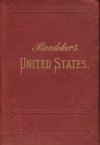
 One of the best finds I’ve ever made at a used book sale was a bundle of red Baedeker’s Guide Books, tied together neatly with twine– six of them for a dollar. They were dated from 1903 to 1938, and covered Paris, Great Britain, Palestine and Syria, Northern Italy, Spain and Portugal, Norway and Sweden. It wasn’t until after I’d given them all (but one) away as gifts that I realized they were worth at least $100 each. Karl Baedeker began publishing travel books in 1827, and by the turn of the century the small red volumes had become so associated with tourism that the name Baedeker was used to describe any guide book, the way Kleen-ex is used to describe any facial tissue.
I never met Margaret Van Ruisdale, or anyone who knew her. But I do know several things about her. She lived at 433 something-Hunt, South Amboy, New Jersey. South Amboy, New Jersey is just across the bay from Perth Amboy, and was a pretty toney suburb of New York City in 1903. I know from her name – clearly Dutch, that she, or her husband (if she had one), were part of an old, New Amsterdam family. I also gather that she dreamed of going to Trondheim, Norway because her Baedeker naturally falls open, after more than 100 years, to the page about that historic port city. The page is not marked by the little green ribbon – that marks Odenhal. Her Baedeker doens’t fall open to page 219 because of the stitching. It falls open there because that is where she kept it open.
From the Baedeker we find that in 1903, Trondheim was a city of wide streets, and a population of about 38,000. It was (and is) one of the finest ports in the world, and Norway’s third largest city. The city was originally called Nidaros, but that gave way to Trondhiem in the 16th century. Christianity came to Trondheim in 996, and there is a fine cathedral of mixed Romanesque and Gothic design. The tourist post and telegraph office, in 1903, was to be found at Nordre Gaden adjoining the Frue-Kirke – which is convenient if you have a sweet tooth because Erichsen, the city’s finest confectioner, is immediately behind the Frue-Kirke.
The wonderful thing about a Baedeker is that it has just enough literary flair that you get a little of the experience of being there. This is something you don’t get from a Fodor’s, a TripTik, or from mapquest. It isn’t hard to imagine the picturesque Free-Church, with the telegraph office just across the way and the candy store behind. Then again, having never been to Trondheim, and since not even my grandmother was alive in 1903 (my great-grandmother was 2), I don’t know if what I imagine bears any resemblance to what is being described. There is something else I don’t know: Did Margaret Van Ruisdale ever make her trip to Trondheim?
Did she tour the Cathedral, sample the lingonberry lozenges at Erichsen’s, take the tramway from Lademoen to Ihlen, enjoy one of the baths (warm, vapour, and Turkish available to all – Sea Baths available to gentlemen only) at Dronnings-Gaden? I doubt it. The book is too pristine to have made a steamer trip across the North Atlantic a hundred years ago. But maybe she went, and left her Baedeker behind.
There is so much here to say, and only a few lines to say it in. There is the truth that a book can make a person live across the decades, and a place live across the miles. There is the way a book prepares you for a place, informs you about it, but cannot replicate the experience of being at that place. There is the way clues and bits of truth can be connected, like pieces of a jigsaw puzzle, to create a picture that emerges clear. There is the truth that knowing about a place, and longing for it, are not the same as going there – and all of it important because God has given us a book through which we get to know a Person – Jesus – and from which we learn about, and begin to long for a place – Heaven.
God gives us a book – a book that is alive (Hebrews 4.12), that allows us to experience Jesus (I John 1.1ff), that thoroughly equips and prepares us (II Timothy 3.16-17), and that in various passages describes our destination - a place beyond our experience. The book prepares us for the journey, guides us though it, sustains us on it – but the book is not the journey. Living is the journey – living with God, for God, and as God wills. That is how we get there– how we get home.
